THE BIGGEST PADDLEBOARDING MISTAKES THAT BEGINNERS MAKE

Stand up paddleboarding looks simple from the shore. You jump on a board, grab a paddle, and off you go, out across the water.

But you don't know what you don't know, right? After teaching over a thousand of people to paddleboard over the years, I've noticed the same simple mistakes cropping up time and time again. The good news? Most of them are easy to fix, and making a few small adjustments can dramatically improve your confidence, stability, and enjoyment on the water.
Whether you're brand new to paddleboarding or you've only been out a handful of times, here are the biggest beginner mistakes I see and how to avoid them.
1. Not Putting Enough Air in Your Paddleboard
This is one of the most common mistakes with inflatable paddleboards. Many paddlers stop pumping long before they've reached the recommended PSI because the board already feels firm. Or it feels to hard to keep going. However, an under-inflated board flexes more on the water, making it slower and way less stable. A well-inflated board will make balancing feel significantly easier. Upgrading to an electric pump or using a dual chamber pump instead of a single chamber (most cheaper boards come with this), makes pumping up a whole lot easier!
Always check the manufacturer's recommended PSI and inflate your board accordingly. If it has a range, go for the top end. The higher PSI creates greater rigidity, helping the board sit and perform properly on the water.

2. Heading Out Without a Leash or PFD
Your paddleboard is your biggest flotation device, so staying connected to it is crucial.
A leash prevents your board from drifting away if you fall in, especially on windy days when a board can move faster than you can swim. A coiled leash is perfect for everything unless you are surfing. If you are surfing, use a straight leash so it doesn't recoil quickly when you fall in. An ankle or calf cuff is great, unless you are on moving water or somewhere where there is a risk of entrapment, then a waist leash is a must as this is so much quicker to release than trying to reach your ankle, in a moment of difficulty.
Alongside a leash, always wear a Personal Flotation Device (PFD), dress for the water temperature rather than the air temperature, and carry at least two forms of communication. For example:
A mobile phone in a waterproof case
A whistle attached to your PFD
Safety equipment isn't just for experienced paddlers or challenging conditions. It's for everyone, every time. Check out my full gear list here.

3. Celebrating That You've Never Fallen In
Many beginners proudly tell me they've never fallen off their paddleboard. While that might sound like a success, it can actually become a problem. One of the best things you can do is intentionally fall in, or jump into the water somewhere safe, and practise getting back on your board. Knowing you can climb back on quickly removes a huge amount of fear and anxiety. Once you've already got wet, falling in often becomes far less intimidating. Plus, you are already wet so you are way more likely to push yourself and your skills on the board. I love it when people fall in trying something new, it means they are learning!
4. Looking Down at the Board
Your body naturally follows your eyes. When you stare down at your feet or the deck of your board, your posture changes and your balance often becomes less stable. Instead, look ahead and focus on something stationary in the distance, such as a tree, headland, or building. This simple adjustment helps improve balance, posture, and confidence almost instantly. Remember: look where you want to go, not where you are.
5. Not Putting the Paddle Blade Fully in the Water
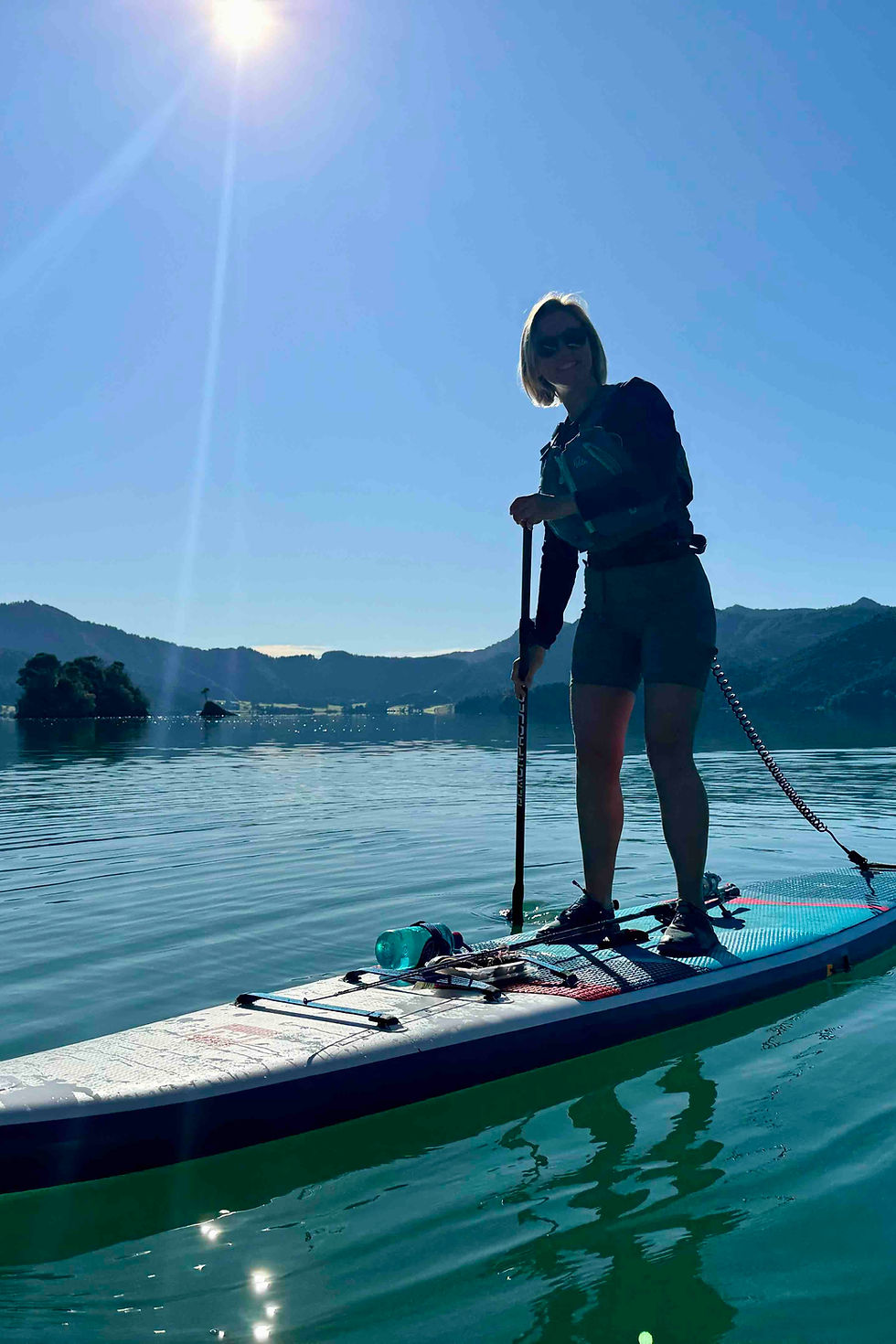
A paddle only works effectively when the entire blade is submerged. Many beginners only dip part of the blade into the water, which reduces power and stability. Think of the paddle as your third point of contact with the water. Every time the blade is planted firmly and fully submerged, it provides support and helps move you forward more efficiently. A strong paddle stroke starts with a solid paddle plant.
6. Standing With Feet Too Wide Apart
When people feel unstable, their instinct is often to spread their feet as wide as possible. Unfortunately, this can makes things worse. A good paddleboarding stance is surprisingly natural. Your feet should be approximately hip-width apart, with soft knees and relaxed posture. When your feet move wider, too close to the rails (the sides of the board), the board becomes more tippy, and can actually feel less stable.
Stand as you would comfortably on land and relax!

7. Not Moving Your Feet
Once we are up on our feet, it can be scary to then let our feet move a muscle! We make little claw grips with our toes, get numb feet as they are so tense, and freeze! Paddleboarding requires movement and adaptability.
Practise:
Moving from kneeling to standing and back to kneeling throughout your paddle
Wiggling your toes whilst you are paddling
Lifting your heels one at a time whilst you are paddling
Shifting weight from one foot to the other whilst you are paddling
Not only does this help your numb feet, it also improves your balance and board control.
8. Thinking Paddleboarding Is an Arm Workout
One of the biggest misconceptions about paddleboarding is that it's all about upper body strength.
In reality, efficient paddling comes from using your larger muscle groups, including your core, glutes, legs, and body weight. Rather than pulling hard with your arms, think about planting the paddle in the water, and allowing your body to move past it.
When you engage your whole body, you'll paddle further, feel less tired, and reduce strain on your shoulders and arms. The best paddlers aren't necessarily the strongest. They're often the most efficient. Learn how to to use your body weight and get more power in your stroke with a lesson, trust me, it will make such a difference!
9. the most common beginner paddleboarding mistake? Leaving the Paddle in the Water Past Your Feet
If I could only fix one thing for paddlers, it would be this. This is the most common mistake I see everyone on the water make, however long they have been paddling.
Many people continue their paddle stroke well behind their body. While it feels like you're generating more power, the opposite is often true. Once the paddle passes your feet, it begins lifting water rather than driving you forward. This can also cause the board to zig-zag from side to side. It also brakes yourself so slows you down.
Instead, focus on removing the paddle from the water when it reaches your toes.
This simple change helps you:
Paddle straighter
Paddle faster
Use less energy
Improve your technique dramatically
Small adjustment. Huge difference. Get someone to paddle with you to check this for you so you are not having to look down at your feet.
Final Thoughts
Nobody starts paddleboarding with perfect technique, and every paddler has made at least one of these mistakes at some point. When I first started paddling, I had the paddle the wrong way, the blade not all the way in. Having my first lesson was the best thing I could do to quickly learn what good looks like.
Confidence doesn't come from avoiding mistakes. It comes from learning, practising, and spending time on the water. Focus on one or two of these tips during your next paddle and you'll be amazed at how much easier paddleboarding feels.
Happy paddling!

Comments